When to See a Speech Therapist
 6 min read
 The question I hear most often, right at the start, is almost always this one: "do you think I should bring him in?". Parents say it carefully, almost apologising for asking. It is a fair question, and it has a concrete answer. An early assessment is not a label: it is a way of looking together at what is happening, and in most cases it serves to reassure.
The milestones of language development, in plain words.
Every child follows their own path, but there are shared windows. Knowing what they are helps parents tell the difference between "he just takes his own time" and "this might be worth a closer look". The milestones I summarise here are the ones recognised by general paediatrics and by Italy's speech and language therapy associations.
- 12-18 months: the first real words appear ("mummy", "food", "water"), and the child understands far more than he can yet say.
- 18-24 months: vocabulary grows to between 50 and 200 words, and the first two-word combinations begin ("water mummy", "away dog").
- 24-30 months: vocabulary grows quickly to between 300 and 500 words, and simple sentences with a subject and a verb appear.
- 30-36 months: sentences become more complete, with articles, prepositions and pronouns. People outside the family should be starting to understand him too.
- 3-4 years: the pronunciation of almost all the sounds of the mother tongue is in place. A few "late" sounds, such as the R, may still be tricky, which is perfectly normal.
- 5-6 years: the child tells stories, understands simple irony, and uses well-formed sentences. This is the age when any phonological difficulties tend to surface, just before starting school.
The two warning signs best documented in the literature are simple: at 24 months a vocabulary of fewer than 50 words, and at 30 months the absence of the first two-word combinations. These are not diagnoses, they are windows of time in which it makes sense not to wait any longer.
The signs a parent can recognise at home.
Parents notice. Almost always before anyone else does. You do not need a manual, you just watch your child doing what he does every day: chatting with his grandparents, playing with other children at the park, asking for water at the table, telling you what he saw on television. We notice the small differences in everyday life, and that is the right place to start.
- Speaks less than children his age: he uses fewer words than other children his age, or he learned them noticeably later.
- Only understood at home: you, mum or dad, always understand him. Outside the home, grandparents aside, people find it hard.
- Sounds that are always missing: he consistently drops or swaps the same sounds, not just occasionally. The R is slow to appear (which can be perfectly normal up to age 5), or he simplifies consonant clusters ("tar" for "star", "pay" for "play").
- Does not respond when you call him: he seems not to hear, but his hearing has been checked and is within normal limits. This can be a sign of a possible difficulty with attention or comprehension, not always with hearing.
- Short or jumbled sentences: at 3 to 4 years he still does not build full sentences, or he puts the words in the wrong order ("bring daddy the ball" instead of "daddy brings the ball").
- Gets upset when he cannot make himself understood: he understands everything but cannot get it out. He becomes frustrated, cries, or shuts down and stops trying. This emotional side matters just as much as the language side.
When it makes sense to wait, and when to get in touch instead.
There is no "right" age to bring a child to me. There are natural windows in which waiting is sensible, and moments when a conversation is worth having. The rule I give parents is simple: if the difficulty is shifting, even slowly, you can usually keep watching. If it has stayed exactly the same for months, or if you have a feeling that "something here isn't quite right", let's talk about it.
There is one figure worth keeping in mind, because it explains why an early assessment is not over-caution: about half of children with a phonological disorder at preschool age go on to develop a specific learning disorder, what at school is called SLD. The persistence of phonological difficulties beyond the age of four is one of the most studied predictors. This does not mean that every child with an uncertain R will become dyslexic: it means it is a window to look at carefully, because early work on the building blocks of written language genuinely makes a difference.
What happens at the practice during an assessment.
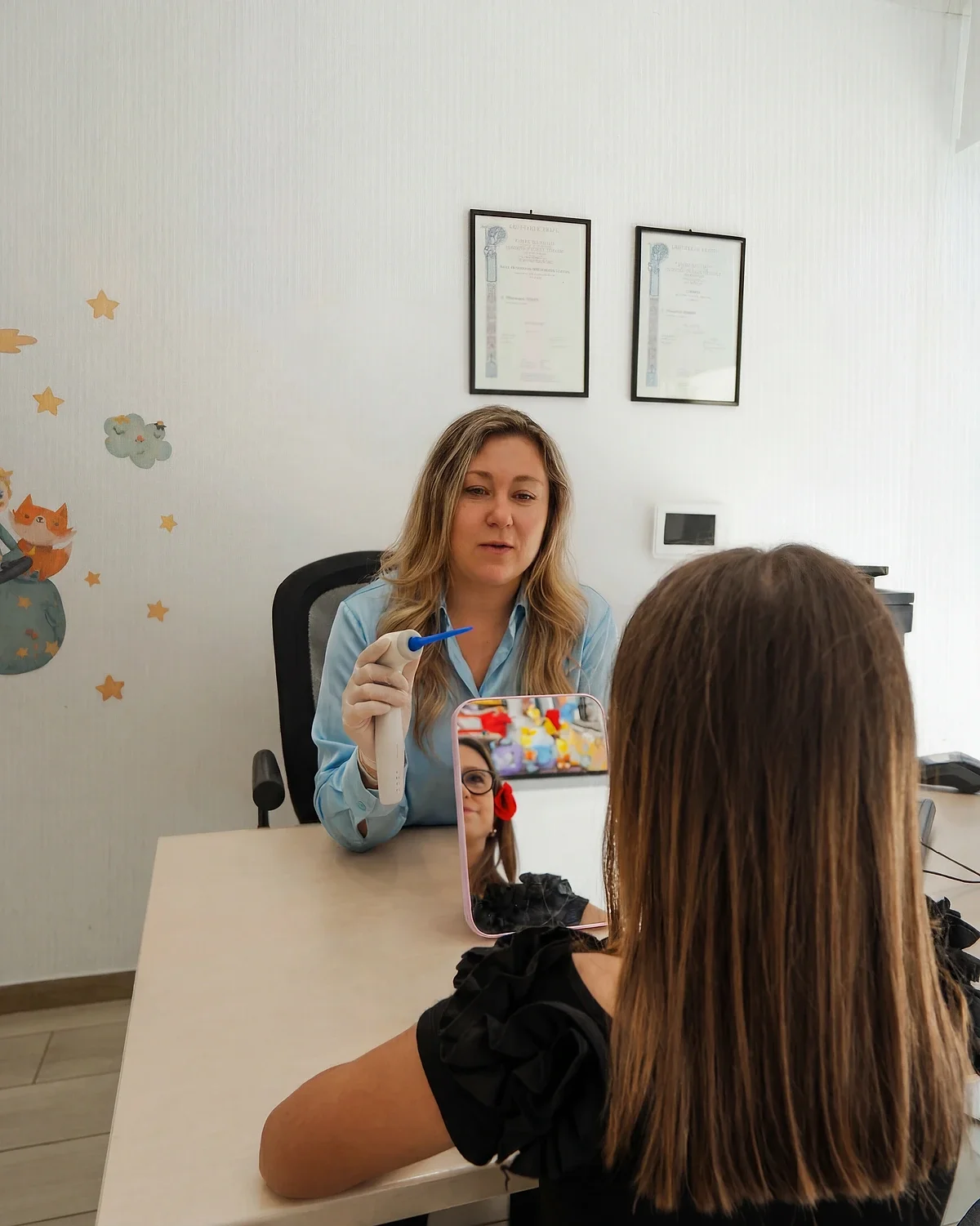
The first meeting is not an exam, it is a conversation. I speak to the child first, not the parent: I ask him his name even though I already know it, we say hello, I let him feel that he is here to play. Plenty of them call me doctor, but I much prefer "super teacher", and I say so straight away: it helps to put him at ease.
The assessment usually wraps up within three meetings, adjusted to the child's age and circumstances. With a two-year-old it can take a few more meetings, to give him time to build trust. With an eight-year-old, sometimes one is enough. Across these meetings I gather a thorough case history with the parents (how the early stages of life went, any family history, how communication has developed), I observe the child at play and in activities, I administer standardised tests, and I look at the anatomy of the mouth and at phonological awareness, which is the ability to recognise the sounds that make up words.
At the end, I report back. I explain to the parents, in clear words, what I have seen, with no jargon and no labels tossed around. If a course of therapy is needed, we build it together with shared goals. If it isn't, I say so plainly. That too is a useful answer, and it happens often.
After the assessment: the network around the child.
Language does not exist in isolation. When it is needed, I coordinate with the child neuropsychiatrist, the school, the paediatrician, the orthoptist for eye movements, the psychologists for the emotional and attentional side, and the SLD tutor when the child is of school age. Working as a network is an overused phrase, but for me it means something concrete: the child is not bounced between professionals who never talk to each other. The various figures call one another, share information with the family's consent, and the child takes one single journey instead of many.
If you are already on an ASL waiting list, private therapy does not replace the public route: it can run alongside it, start sooner, fill the wait. It is a choice you weigh up case by case, honestly.